
Urethane Casting
Introduction
Urethane casting is a manufacturing process commonly used to create parts that mimic the look and feel of injection-molded plastic, but without the hefty investment in expensive hard tooling. It’s a popular choice for those who need realistic parts quickly but aren’t ready to commit to full-scale production. This process is ideal for low-volume production runs, making it a go-to for testing, demos, and early sales before committing to a large, expensive manufacturing process.
Whether you are working on prototypes, pre-production runs, or just need parts in small quantities for market testing, urethane casting offers a cost-effective and flexible solution. Let’s dive into the urethanes casting process, the types of materials used, the cost factors, and some valuable tips to ensure success in your production efforts.
What is Urethane Casting Used for in Production?
Urethane casting is a versatile method used primarily for creating low-volume parts that closely resemble the final, injection-molded product but at a fraction of the cost. It’s particularly useful when design iterations or changes are anticipated before moving into full-scale production. This process provides a quick turnaround for parts that need to meet certain cosmetic and functional requirements while avoiding the high costs of metal tooling typically associated with injection molding.
Urethane casting is not just for prototyping it can also be used for small batch production. Whether you’re preparing parts for testing, product demos, or even early sales, this method can save you both time and money.
How Does Urethane Casting Work?
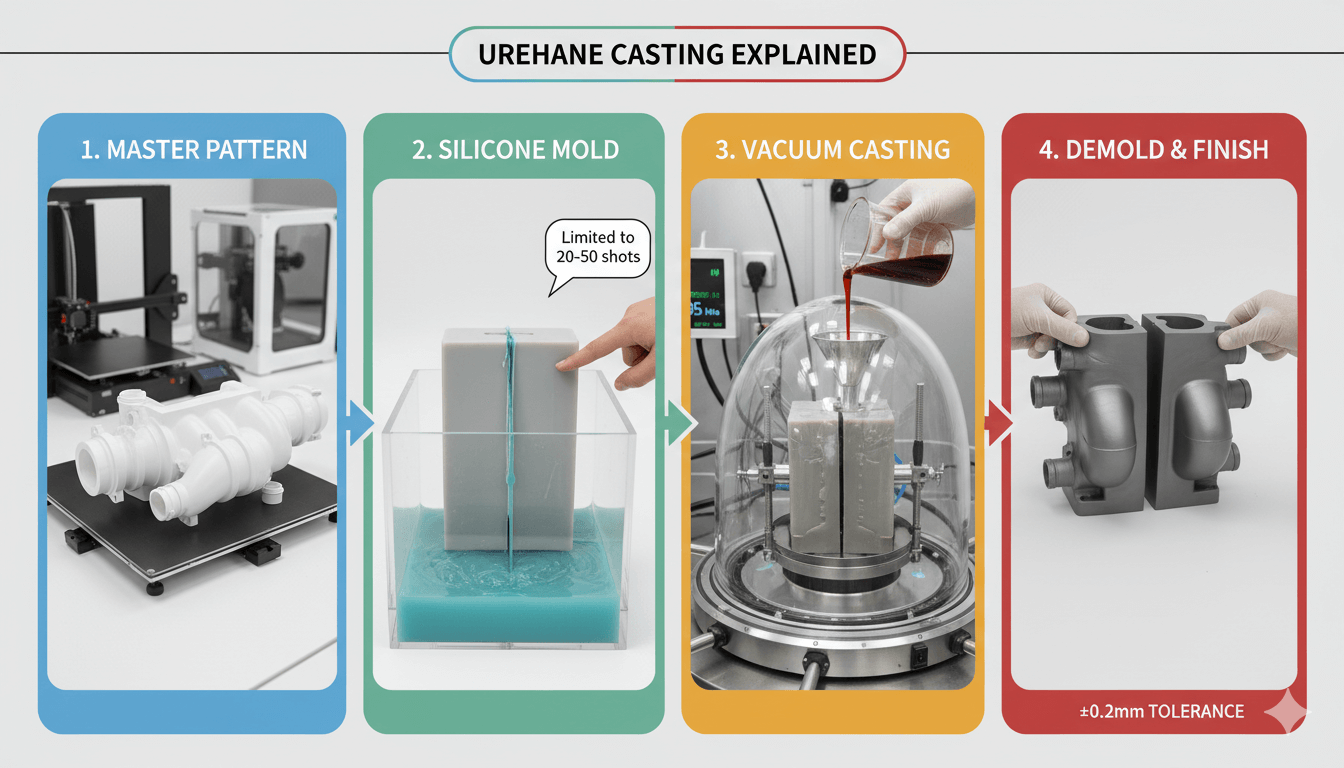
The urethane casting process is relatively simple, but it requires attention to detail. Here’s how it generally works:
1. Master Pattern Creation
First, a master pattern or model of the part is created, typically through 3D printing or CNC machining. This pattern can be made from a range of materials, but 3D printed models are most common due to their speed and accuracy.
2. Mold Making
Next, a mold is made around the master pattern. The mold is usually created from a flexible material, such as silicone rubber, which can capture all the fine details of the master pattern. The mold is then hardened and prepared for casting.
3. Urethane Pouring
Once the mold is ready, urethane resin is poured into the mold. The resin, which comes in various formulations, can be customized for different hardness, colors, and finishes. It can also be infused with various fillers, such as glass beads or fibers, to enhance properties like strength or heat resistance.
4. Curing
After the mold is filled, the urethane resin is cured either at room temperature or under heat depending on the formulation. This process solidifies the resin into the final part.
5. Demolding
Once the resin has fully cured, the mold is opened, and the part is carefully removed. The final product is then finished and polished, if necessary, to achieve the desired surface texture and appearance.
Materials Used in Urethane Casting
The materials used in urethane casting are one of the reasons the process is so flexible and cost-effective. Here’s a breakdown of the materials commonly used:
Urethane Resins
Urethane resins are at the heart of the casting process. These resins come in a variety of hardness levels, from soft and flexible to rigid and strong, making it possible to create parts with different functional properties. Common types of urethane resins include:
- Polyurethane: The most common type of urethane resin, available in various durometers (hardness levels) and suitable for a wide range of applications.
- Flexible Urethanes: For parts that need to mimic rubber, such as gaskets, seals, or grip handles.
- Rigid Urethanes: Used for parts that require more structural integrity, like brackets, housings, and covers.
Mold Materials
The molds are usually made from flexible, durable materials such as:
- Silicone Rubber: Most common for urethane casting, silicone rubber is perfect for capturing fine details.
- Aluminum: Sometimes used for low-volume production if the parts require higher precision and the molds need to withstand repeated use.
- Polyurethane Rubber: This material can be used for simple, inexpensive molds when part details are less critical.
Fillers and Additives
To enhance certain properties of the final part, various fillers and additives can be mixed into the urethane resin before casting. These include:
- Glass Beads: To increase strength and dimensional stability.
- Pigments: For color customization.
- Fibers: Such as carbon fiber for lightweight but strong parts.
Costs Involved in Urethane Casting
The main advantage of urethane casting is its cost-effectiveness compared to traditional injection molding, especially for small batch production. However, it’s still important to understand the factors that influence costs:
1. Mold Creation
Creating the mold can be expensive, depending on the complexity of the part and the materials used for the mold. Silicone molds are relatively cheap but may wear out after several uses. On the other hand, more durable molds made from aluminum or steel can be used for larger production runs but come with higher upfront costs.
2. Material Costs
The cost of urethane resin varies based on the type and hardness of the resin used. Flexible resins tend to be less expensive, while rigid urethanes or those with fillers or custom pigments can drive up material costs.
3. Labor and Setup Time
Although the process is much quicker than injection molding, there is still a time investment in preparing the master pattern, creating the mold, and curing the parts. Labor costs can vary depending on the complexity of the parts being produced.
4. Post-Processing
Once the part is cast, some level of finishing (such as sanding, polishing, or painting) may be required, which will add to the overall cost of the product.
5. Production Volume
For small production runs, urethane casting is much more affordable than traditional injection molding. Typically, the process is ideal for batch sizes ranging from a few units to several hundred parts, making it perfect for prototyping, product testing, and low-volume production runs.
Best-Fit Scenarios for Urethane Casting
Urethane casting is often selected when teams require parts that are:
1. Low-Volume Production Runs
When you need a small batch of parts typically from a few dozen to a few hundred urethane casting offers an affordable alternative to expensive hard tooling. It’s the perfect choice for those who need parts quickly without the commitment to mass production.
2. Prototypes and Testing
Urethane casting is ideal for creating realistic prototypes that can be tested and modified before going into full-scale production. It’s perfect for gathering user feedback, testing product features, and ensuring that the design fits the intended use before committing to costly injection molding.
3. Custom Finishes and Multiple Variations
Urethane casting can also be used when you need parts in different colors, textures, or hardness. Unlike other molding methods, urethane casting allows for customization of these characteristics without the need for different molds.
4. Short Lead Times
If you’re under a time crunch and need parts in a short period, urethane casting can provide a fast turnaround, often within a few days to a couple of weeks, depending on the complexity of the part and quantity needed.
Common Industries Using Urethane Casting
Urethane casting has found its way into a variety of industries where quick production and functional yet visually appealing parts are needed. Some of the most common industries include:
1. Medical Devices
Urethane casting is often used in medical device prototyping, where parts must not only meet functional specifications but also exhibit high-quality finishes and the appropriate feel for final users. Components like handles, casings, and bezel covers are made using urethane casting.
2. Automotive
In the automotive industry, urethane casting is used to create parts for interiors, such as dashboard components, knobs, and panels, where both aesthetic appeal and durability are key considerations.
3. Consumer Electronics
Urethane casting is common for consumer electronics products, including protective casings, buttons, and housings. The process ensures that these parts look sleek and polished while maintaining strength and resistance to wear and tear.
Costs of Urethane Casting
Urethane casting offers a compelling cost profile for specific production volumes.
- Low Tooling Costs: This is the primary advantage. Silicone molds are much cheaper to produce than hard tooling (steel or aluminum molds) for injection molding. This makes it ideal for short runs.
- Volume Sweet Spot:
- Too Low (1-5 parts): For very few parts, 3D printing directly might be more economical.
- Just Right (10-500 parts): This is where urethane casting shines. The cost per part is reasonable, and the tooling cost is amortized over a manageable number of units. Multiple silicone molds can be made from one master pattern to increase capacity.
- Too High (1,000+ parts): For very high volumes, injection molding typically becomes more cost-effective due to its much lower per-part cost, despite the high initial tooling investment.
- Part Complexity: More complex parts might require more intricate master patterns and silicone molds, slightly increasing costs.
- Material Choice: Specialized resins (e.g., clear, high-temp, flame-retardant) can be more expensive than general-purpose ones.
- Post-Processing: Extensive finishing, painting, or assembly will add to the overall cost.
General Cost Breakdown:
- Master Pattern: Depends on size, complexity, and manufacturing method (3D print, CNC).
- Silicone Mold: Main tooling cost, varies by size and complexity.
- Materials: Cost of the resin per part.
- Labor: For casting, demolding, and finishing.
Tips for Successful Urethane Casting
- Design for Castability:
- Draft Angles: While less critical than for injection molding, incorporating slight draft angles (1-3 degrees) can ease demolding and extend mold life.
- Wall Thickness: Aim for consistent wall thickness to prevent warping or sink marks during curing. If variations are necessary, make transitions gradual.
- Undercuts: Urethane casting can handle moderate undercuts because the silicone mold is flexible. However, complex undercuts might require multi-part molds or inserts, increasing complexity and cost.
- Tolerances: Urethane casting typically achieves tolerances of ±0.2mm for the first 100mm, then ±0.002mm/mm for larger dimensions. This is generally good, but not as precise as injection molding.
- Surface Finish is Key:
- The finish of your master pattern directly determines the finish of your cast parts. If you want a smooth, glossy part, the master must be perfectly smooth and polished. If you want texture, apply it to the master.
- Color Matching:
- Provide a precise RAL or Pantone code for color matching if specific aesthetics are required. Be aware that subtle color shifts can occur between batches.
- Consider Inserts:
- Metal inserts (e.g., threaded inserts) can be cast directly into parts, saving assembly time.
- Understand Lead Times:
- While much faster than injection molding (weeks vs. months), there’s still a lead time for master pattern creation, mold making, and casting. Plan accordingly.
- Prototype First:
- It’s often wise to cast a single prototype or a small batch first to verify design, material properties, and aesthetics before committing to a larger production run.
- Partner with an Experienced Manufacturer:
- A good casting service can advise on design for manufacturability, material selection, and post-processing options to ensure the best possible outcome for your project.
Conclusion
Urethane casting is a versatile, cost-effective, and flexible method for producing low-volume parts quickly. Its ability to create realistic, high-quality parts at a fraction of the cost of injection molding makes it the ideal solution for a wide variety of industries, including medical devices, automotive, and consumer electronics. With its use of customizable resins and ability to accommodate design changes, urethane casting will continue to be a popular choice for companies needing small production runs or prototype parts before committing to full-scale manufacturing.
FAQs
1. What are the main advantages of using urethane casting for small production runs?
Urethane casting is an ideal solution for small-volume production due to its cost-effectiveness and speed. It allows manufacturers to produce realistic, high-quality parts without the significant upfront costs of traditional injection molding. With fast turnaround times, custom finishes, and the ability to make design changes quickly, urethane casting is the go-to choice for prototyping, market testing, and low-volume manufacturing.
2. How long does the urethane casting process take to produce parts?
The urethanes casting process typically takes anywhere from a few days to a couple of weeks, depending on the complexity and quantity of parts needed. For simple, small-batch runs, parts can be produced in as little as 48 to 72 hours, making urethane casting one of the fastest methods for creating functional, aesthetic prototypes or short-run products.
3. Can urethane casting be used for parts with high durability requirements?
Yes, urethane casting can be tailored to meet high durability requirements. Urethane resins can be formulated to enhance properties such as abrasion resistance, flexibility, and impact resistance. By selecting the right resin and incorporating additives like fiberglass or glass beads, manufacturers can create durable parts that withstand wear and tear in industries like automotive and medical devices.
4. What industries benefit the most from urethane casting?
Urethane casting is widely used across industries that require low-volume production of high-quality, functional parts. Key industries include automotive, where it’s used for interior components; medical devices, for functional prototypes; and consumer electronics, for producing protective housings and buttons. Its flexibility also benefits designers and engineers in many fields that need quick, customizable solutions.
5. How can I ensure the highest quality when using urethane casting for prototypes?
To achieve the highest quality when using urethane casting for prototypes, ensure that you are using high-quality resins, a well-prepared mold, and a controlled curing process. Additionally, thorough post-processing, such as sanding or polishing, can improve the part’s appearance and function. Choosing a reputable manufacturer who uses advanced mold-making techniques and offers customized resin options will also ensure top-notch results.
You may also read: SSIS 950 Guide: Explore Features, Benefits, and Pro Tips for 2026
Jade Venison: Mastering the Art of Herb-Infused Game Meat Culinary Excellence
For More Information, visit usbizzbuzz
About the Author