

Utah Jazz vs Miami Heat Match Player Stats
The NBA has long been home to thrilling matchups, but the clash between the Utah Jazz and Miami Heat stands out for its intensity and unpredictable outcomes. With each season, these two teams continually evolve, bringing new players and strategies that add complexity to their encounters. A look at the Utah Jazz vs Miami Heat player stats can provide valuable insights into the tactical decisions both teams make. This article delves into these statistical trends, the performances of key players, and the dynamics that shape these encounters.
Game Overview
The Utah Jazz vs Miami Heat games are always filled with excitement due to their distinct styles of play. The Jazz, known for their team-oriented basketball and the ability to distribute scoring across the roster, often look to control the pace of the game with heavy ball movement and shooting depth. Their offense is built around versatile players who can stretch the floor and create opportunities both inside and out.
On the other hand, the Miami Heat possess a dominant defensive scheme led by Bam Adebayo, combined with a high-scoring offense fueled by Tyler Herro, Nikola Jovic, and Andrew Wiggins. The Heat focus on forcing turnovers, controlling the paint, and utilizing their depth to rotate quickly in a fast-paced offense.
The February 2026 game between these two teams was a compelling showcase of their respective styles, with the Jazz emerging victorious in a hard-fought battle. By the end of the match, Utah’s ability to lock down on defense and utilize bench depth ultimately outmatched Miami’s quick-paced offense.
Game Recap
Utah Jazz 115 – Miami Heat 111
In one of the most exciting games of the 2025-26 NBA season, the Utah Jazz narrowly defeated the Miami Heat in a game that kept fans on the edge of their seats until the final buzzer. Here’s a breakdown of how the game unfolded:
First Half:
The game started at a frenetic pace, with both teams eager to establish dominance. Miami came out strong, led by Andrew Wiggins, who quickly established himself as a primary scorer. Tyler Herro’s sharpshooting from beyond the arc also proved effective, giving Miami an early advantage. However, Utah responded with their own firepower, as Lauri Markkanen and Jaren Jackson Jr. spearheaded their offense. Utah’s ability to stay patient and methodically execute their offense kept them within striking distance despite Miami’s early surge.
Second Half:
The intensity only increased in the second half. Jaren Jackson Jr. played a pivotal role in Utah’s comeback, contributing both offensively and defensively with timely shots and rim protection. Jusuf Nurkić, though not scoring as much, made his presence felt on the glass, grabbing key rebounds to give Utah second-chance opportunities.
Miami, led by Bam Adebayo, struggled to break through Utah’s defense. Adebayo was consistent, but Miami’s shooting went cold at critical junctures, particularly from beyond the arc. Utah’s defense took advantage of these slumps, limiting Miami’s offensive flow with a series of successful defensive schemes.
Final Moments:
As the game wound down, Brice Sensabaugh and Isaiah Collier came through with crucial shots. Sensabaugh, in particular, hit a clutch 3-pointer late in the game to extend Utah’s lead. Despite a valiant effort from Miami in the final minutes, Utah held on for a four-point victory.
Key Team Statistics: The Ground Game Difference
A crucial factor in the Utah Jazz vs Miami Heat matchups is the ground game—the performance of both teams inside the paint and on the boards. Despite their perimeter shooting strength, both teams rely heavily on their big men to dominate the paint and secure essential rebounds. Here’s a breakdown of how each team performs in the paint:
| Statistic | Utah Jazz | Miami Heat |
| Points in the Paint | 48.7 PPG (Avg) | 46.2 PPG (Avg) |
| Rebounds per Game | 45.5 RPG (Avg) | 42.1 RPG (Avg) |
| Offensive Rebounds | 10.3 ORPG (Avg) | 9.0 ORPG (Avg) |
| Defensive Rebounds | 35.2 DRPG (Avg) | 33.1 DRPG (Avg) |
| Second Chance Points | 14.5 PPG (Avg) | 13.8 PPG (Avg) |
As the table above shows, Utah Jazz has a slight edge over the Miami Heat in rebounding and second-chance points, which reflects their ability to control the boards and gain more opportunities for offensive rebounds. The Jazz’s larger rebounding margin especially on the offensive boards provides them with more chances to convert missed shots into points.
In contrast, Miami’s defensive presence inside, particularly from Bam Adebayo and Nikola Jovic, makes them a formidable force in the paint, though they slightly trail the Jazz in terms of overall ground game dominance.
Utah Jazz Player Statistics
The Utah Jazz boasts several key players who make substantial contributions in both offensive and defensive aspects of the game. Here’s a deeper look at some of the standout player statistics for the team:
Lauri Markkanen
- Points Per Game (PPG): 26.7
- Rebounds Per Game (RPG): 8.0
- Assists Per Game (APG): 2.5
- Field Goal Percentage (FG%): 49.2%
- 3-Point Percentage (3P%): 39.4%
Markkanen continues to be the primary scoring option for the Jazz, thriving in both isolation and pick-and-roll scenarios. His shooting efficiency from beyond the arc makes him a matchup nightmare for opposing teams.
Jaren Jackson Jr.
- Points Per Game (PPG): 22.4
- Rebounds Per Game (RPG): 10.3
- Blocks Per Game (BPG): 3.2
- Field Goal Percentage (FG%): 47.8%
- Free Throw Percentage (FT%): 84.1%
Known for his elite defense, Jackson has elevated his offensive game, providing consistent scoring while continuing to dominate defensively with his block totals. His presence in the paint gives the Jazz a solid defensive anchor.
Jusuf Nurkić
- Points Per Game (PPG): 14.7
- Rebounds Per Game (RPG): 10.9
- Assists Per Game (APG): 4.1
- Field Goal Percentage (FG%): 53.1%
- Defensive Rebounds: 6.3
Nurkić brings an inside presence for the Jazz, contributing significantly in both the offensive rebounding and playmaking aspects. His physicality in the paint allows the Jazz to control the boards and secure critical second-chance opportunities.
Isaiah Collier
- Points Per Game (PPG): 12.3
- Assists Per Game (APG): 5.4
- Rebounds Per Game (RPG): 4.1
- Steals Per Game (SPG): 1.5
- 3-Point Percentage (3P%): 34.0%
A solid playmaker, Collier’s ability to create for others while also contributing as a secondary scorer has helped balance the Jazz offense. His defensive contributions are also essential to the team’s success.
Miami Heat Player Statistics
The Miami Heat have built a strong team around their defensive prowess and efficient scoring. Here’s a breakdown of some of their key players and their impact:
Bam Adebayo
- Points Per Game (PPG): 20.4
- Rebounds Per Game (RPG): 11.2
- Assists Per Game (APG): 4.3
- Blocks Per Game (BPG): 1.7
- Field Goal Percentage (FG%): 55.2%
Adebayo continues to be the centerpiece of the Heat’s lineup, providing both offensive production and elite rim protection. His scoring efficiency and rebounding abilities make him a pivotal factor in Miami’s success.
Tyler Herro
- Points Per Game (PPG): 22.8
- Rebounds Per Game (RPG): 5.1
- Assists Per Game (APG): 3.8
- Field Goal Percentage (FG%): 46.5%
- 3-Point Percentage (3P%): 37.8%
As Miami’s primary scorer, Herro has developed into one of the NBA’s most dangerous shooters, particularly from deep. His offensive game opens up scoring opportunities for the Heat in isolation and team offense scenarios.
Nikola Jovic
- Points Per Game (PPG): 15.4
- Rebounds Per Game (RPG): 6.5
- Assists Per Game (APG): 3.2
- Steals Per Game (SPG): 1.1
- Field Goal Percentage (FG%): 47.2%
Jovic has provided Miami with a versatile forward capable of contributing across multiple facets of the game. His size and playmaking ability allow him to fill multiple roles, both as a scorer and facilitator.
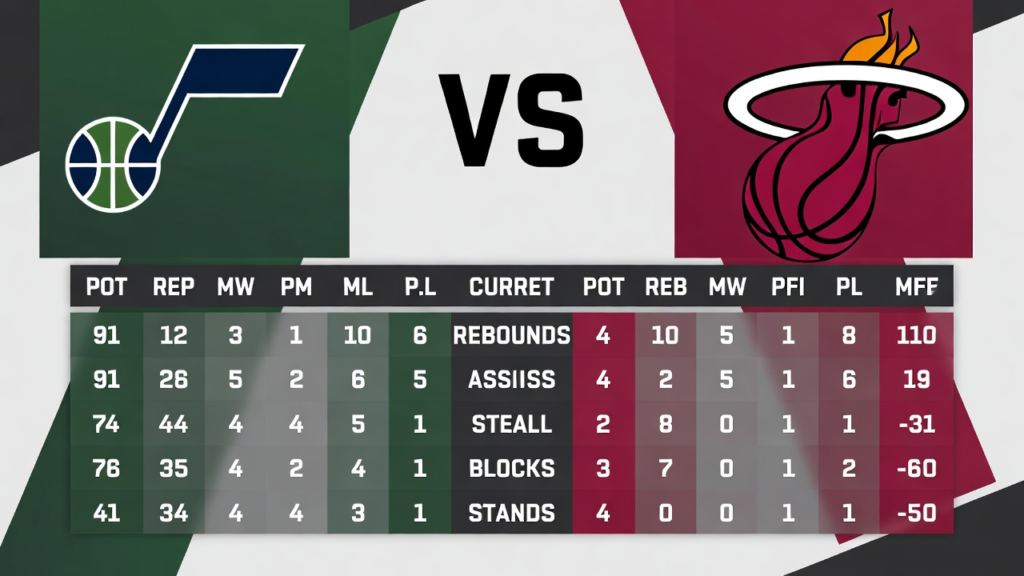
Analyzing the Impact of Bench Players in Utah Jazz vs Miami Heat Games
While the stars shine bright in games, it’s often the bench players who bring unexpected depth and energy. Brice Sensabaugh and Keyonte George of the Jazz provide much-needed scoring from the bench, especially in high-pressure moments.
On the Heat’s side, players like Nikola Jovic and Max Strus contribute in significant ways, adding both scoring and defensive versatility when the team needs it most.
Bench depth often plays a decisive role in how games unfold, and both teams understand the value of having reliable second-unit players.
Player Efficiency Ratings (PER): Comparing Jazz and Heat Stars
The Player Efficiency Rating (PER) is one of the most comprehensive stats to evaluate individual performances. It weighs the player’s total contributions against minutes played and overall team performance. When analyzing both teams:
- Lauri Markkanen leads the Jazz with an impressive PER of 22.4, demonstrating his offensive efficiency.
- Bam Adebayo of Miami averages a PER of 24.5, showcasing his defensive efficiency and offensive consistency.
Both players are performing well above league averages, and this is reflective of their all-around skill sets.
The Role of Three-Point Shooting in Utah Jazz vs Miami Heat Matchups
In modern basketball, three-point shooting has become a major determinant of success. Both the Jazz and Heat have a strong emphasis on long-range shooting, and their success from beyond the arc can often decide the outcome of games.
For the Jazz, players like Lauri Markkanen and Brice Sensabaugh are key perimeter threats. Utah often uses a spread offense, encouraging ball movement and driving lanes that open up for shooters.
On the Heat’s side, Tyler Herro and Pelle Larsson have been especially effective from deep. Miami has shown that their three-point shooting, when effective, allows them to stretch the floor, creating space for the paint and driving lanes.
Defensive Strategies: How Utah and Miami Adapt Against Each Other
Defensive schemes are critical when teams face off against each other. The Utah Jazz and Miami Heat both have unique defensive setups that capitalize on their strengths.
The Jazz’s defense typically relies on their rim protection from Jusuf Nurkić and Jaren Jackson Jr., who can disrupt opposing offenses. Their switch-heavy schemes and help defense have become more effective as the season has progressed.
The Heat’s defense is anchored by Bam Adebayo, who can guard multiple positions. Miami also often employs a 3‑2 zone to contest shots and block passing lanes. This scheme, combined with aggressive on-ball defense, has given them an edge in several games.
Fast Break and Transition Play: Speed in Utah Jazz vs Miami Heat Matchups
Both teams rely on transition play to gain quick points. The Jazz excels in pushing the tempo, especially with younger players like Isaiah Collier, who can ignite fast breaks with his playmaking.
Similarly, the Heat use their athleticism and defensive stops to fuel transition opportunities. With players like Herro and Adebayo, they have the ability to convert defensive rebounds into quick scoring opportunities.
The speed at which these teams transition from defense to offense can often be a decisive factor in their matchups.
Key Stats to Focus on in Utah Jazz vs Miami Heat Matchup
When analyzing any NBA game, certain statistics stand out. Here are the key stats to focus on when the Utah Jazz meets the Miami Heat:
- Points in the Paint – Both teams rely on scoring in the paint, and whoever dominates inside often controls the game.
- Turnovers – Ball control is crucial, and both teams must limit turnovers to maintain offensive rhythm.
- Free-Throw Percentage – With close games, making free throws in clutch moments is essential.
Injury Impact on Player Stats in Recent Jazz-Heat Games
Injuries have a significant impact on player performance and overall team dynamics. Both the Jazz and Heat have dealt with injuries, especially during key matchups.
For the Jazz, the loss of key players like LaVine for short stretches has impacted their scoring depth. On the other hand, Miami has struggled with inconsistent availability from players like Tyler Herro during the regular season. These absences create opportunities for bench players to step up, but also bring challenges in maintaining rhythm.
The Tactical Battle: Coaching and Adjustments in Jazz-Heat Games
Coaching strategies play a massive role in how the Jazz and Heat match up. Both teams have intelligent, adaptable coaches in Will Hardy for Utah and Erik Spoelstra for Miami, both of whom can shift game plans on the fly.
In the Jazz-Heat matchups, adjustments on defensive coverages and offensive sets have often been made in response to hot streaks or cold shooting spells, and this adaptability is crucial.
The Final Whistle: Utah Jazz vs Miami Heat Match Player Stats
After a thrilling contest, the final buzzer marked another exciting chapter in the rivalry between the Utah Jazz and Miami Heat. The Jazz’s defensive composure and balanced offensive attack secured a 115-111 victory, but the Heat, with their offensive firepower and defensive resilience, remained competitive throughout the game.
Key stats like rebound control, points in the paint, and defensive efforts were crucial in determining the outcome of the match. Players such as Bam Adebayo, Jaren Jackson Jr., and Tyler Herro led their respective teams in pivotal moments, but it was the Jazz’s depth and ability to capitalize on second-chance opportunities that ultimately made the difference.
What’s Next for Both Teams?
Looking ahead, both the Utah Jazz and Miami Heat have their sights set on the playoffs. Utah, with a balanced roster and emerging young stars, will need to continue to focus on defense and rebounding to secure crucial wins down the stretch. The contribution from their bench players, including Brice Sensabaugh and Isaiah Collier, will be vital in maintaining consistent offensive pressure.
For Miami, the Heat’s playoff hopes rest on the shoulders of Bam Adebayo and Tyler Herro, who must stay healthy and consistent. Miami’s ability to force turnovers and dominate the defensive boards will play a huge role in their future matchups. Miami will also need to rely on their depth, particularly from Nikola Jovic and Max Strus, to provide scoring support when needed.
Both teams will face intense competition in the coming weeks, but if they can continue to build on their strengths, both the Jazz and Heat are poised to make significant runs in the 2025-26 playoffs.
Conclusion
As the Utah Jazz and Miami Heat continue their rivalry in the 2025-26 season, player stats provide a blueprint for both teams’ strengths and weaknesses. Key performers like Bam Adebayo and Jaren Jackson Jr., coupled with tactical coaching adjustments, will likely determine how future matchups play out.
Looking ahead, it’s clear that both teams will need to maintain consistent performances across the board to stay competitive. Understanding these player stats and how they interact on the court will be crucial for both teams’ playoff aspirations.
(FAQs) Frequently Asked Questions
1. Who won the Utah Jazz vs Miami Heat game in February 2026?
In February 2026, the Utah Jazz secured a 115-111 victory over the Miami Heat in a highly competitive matchup. The game saw Jaren Jackson Jr. and Lauri Markkanen lead the Jazz offensively, while Bam Adebayo and Tyler Herro tried to keep the Heat in the game. Despite Miami’s efforts, the Jazz’s defensive strategies and effective bench contributions allowed them to close out the game in a thrilling final stretch.
2. How do the Utah Jazz and Miami Heat compare in key player stats?
When comparing key player stats, both teams bring elite performances to the court. Lauri Markkanen of the Jazz leads the team with 26.7 points per game, showing his scoring consistency. Meanwhile, Bam Adebayo of the Miami Heat continues to dominate with 20.4 points per game and 11.2 rebounds, establishing himself as a defensive force. Both players are pivotal to their teams’ success, with Markkanen’s perimeter shooting and Adebayo’s paint presence playing a key role in their respective team strategies.
3. What are the key stats to focus on in Utah Jazz vs Miami Heat matchups?
In matchups between the Utah Jazz and Miami Heat, the following stats are crucial:
Points in the Paint: Both teams rely heavily on their inside game, with Utah Jazz averaging 48.7 points in the paint per game, slightly edging out Miami Heat’s 46.2 points.
Rebounds: Utah Jazz excels in rebounding, averaging 45.5 rebounds per game, including 10.3 offensive rebounds a key stat for second-chance opportunities.
Turnovers: Limiting turnovers is vital, with both teams needing to maintain ball control to capitalize on their offensive plays and defensive setups.
These metrics not only reveal each team’s strengths but also highlight their game strategy and execution.
4. How do Utah Jazz’s defensive strategies give them an edge against Miami Heat?
The Utah Jazz’s defense is structured around rim protection and rebounding, with Jaren Jackson Jr. providing exceptional shot-blocking and Jusuf Nurkić dominating the boards. Their switch-heavy defense and help defense disrupt the Miami Heat’s offensive flow, especially when Tyler Herro and Nikola Jovic are cold from deep. This defensive capability, combined with Utah’s ability to capitalize on second-chance opportunities, gives them a strategic advantage in close games against teams like the Heat.
5. What’s next for Utah Jazz and Miami Heat in the 2025-26 NBA playoffs?
Looking ahead to the 2025-26 NBA playoffs, both the Utah Jazz and Miami Heat have strong playoff potential. Utah Jazz will need to continue building on their balanced offense, led by Lauri Markkanen and Jaren Jackson Jr., while focusing on defensive consistency. For Miami Heat, the key to success lies in maintaining health and performance from their core players, particularly Bam Adebayo and Tyler Herro, while leveraging their defensive prowess to control games. The Jazz’s depth and Heat’s defensive schemes will be key factors in determining how far each team advances in the postseason.
You may also read: Bengals vs Dallas Cowboys Match Player Stats: A Comprehensive Breakdown & Analysis
49ers vs Kansas City Chiefs Match Player Stats: Key Ground Game Stats Breakdown
For More Information, visit usbizzbuzz
About the Author


